


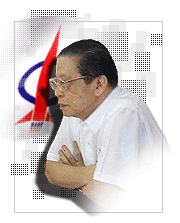


Pemilihan Umno: Ku Li harap dapat regu dari Sabah
Oleh Berita Harian
Isnin, 26 Mei 2008
KOTA KINABALU: Ahli Parlimen Gua Musang, Tengku Razaleigh Hamzah sedia bergandingan dengan pemimpin Umno dari Sabah untuk merebut dua jawatan tertinggi pada pemilihan pucuk pimpinan parti, Disember ini.
Beliau yang juga Ahli Majlis Tertinggi (MT) Umno berkata, dengan adanya pemimpin dari Sabah menduduki jawatan lebih tinggi dalam hiraki parti, pelbagai masalah dibangkitkan rakyat negeri itu akan dapat ditangani secara lebih berkesan.
"Tidak salah jika ahli Umno Sabah dicadangkan bagi jawatan lebih tinggi daripada MT, hatta ke kerusi nombor dua (Timbalan Presiden) sekali pun. Jika pemimpin dari Sabah dapat mengisi kedudukan tinggi dalam parti, saya yakin banyak masalah negeri ini dapat diatasi.
"Saya sedia menerima siapa saja (sebagai gandingan) dan saya sudah pun mengenal pasti tokoh sesuai dari Sabah, tetapi kerana tidak mahu bersikap prejudis, maka biarlah ahli Umno Sabah sendiri menilai dan memilihnya.
"Mesej saya kepada semua ahli Umno ialah mari kita bawa perubahan," katanya selepas menghadiri Majlis Salam Mesra Bersama Akar Umbi Sabah di Pacific Sutera Harbour Resort, di sini, malam kelmarin. Majlis selama kira-kira dua jam itu dihadiri veteran Umno, pemimpin peringkat bahagian dan cawangan Umno negeri.
Tengku Razaleigh berkata, beliau juga akan bersikap terbuka untuk bergandingan dengan Timbalan Presiden Umno, Datuk Seri Najib Razak, tetapi menegaskan adalah lebih baik dan berkesan jika gandingannya itu adalah wakil Sabah supaya lebih perhatian dapat diberi kepada negeri itu.
Ditanya mengenai keyakinannya mendapat jumlah pencalonan mencukupi untuk melayakkannya bertanding merebut jawatan Presiden Umno, beliau secara berseloroh menjawab: "Saya yakin, seperti mana anda (wartawan) juga".
Mengikut sistem kuota Umno, individu yang ingin bertanding jawatan Presiden parti hanya layak berbuat demikian jika mendapat sekurang-kurangnya 30 peratus pencalonan daripada 191 bahagian sedia ada atau minimum 58. Sabah mempunyai 25 bahagian Umno.
Mengulas tiada seorang pun ketua bahagian Umno menghadiri perjumpaan malam kelmarin, Tengku Razaleigh berkata: "Mereka terlalu sibuk untuk menemui saya... masing-masing ada hal sendiri, maka saya jumpa dengan ketua cawangan sajalah".
Bagaimanapun, difahamkan ketua bahagian tidak diundang ke majlis berkenaan.
Terdahulu ketika berucap selama 25 minit, Tengku Razaleigh antara lain membangkitkan isu royalti minyak dan mendakwa Sabah tidak menerima pembahagian yang adil.
"Perhitungan yang dibuat mereka di Kuala Lumpur tidak betul dan tidak adil... mereka tidak faham keadaan di Sabah. Saya tengok rakyat Sabah dan Kelantan ada persamaannya kerana mereka berani tukar kerajaan beberapa kali.
"Saya datang sini bukan sekadar mahukan saudara tepuk tangan, tetapi saya mahukan pencalonan untuk bertanding jawatan Presiden Umno. Saya dah kata rakyat Sabah berani, maka buktikanlah kerana masalah di Sabah boleh diselesaikan jika rakyatnya mahu ia diselesaikan," katanya.
Dalam sesi dialog selepas itu, Tengku Razaleigh ketika ditanya mengenai perancangannya jika gagal mendapat jumlah pencalonan mencukupi bagi bertanding merebut jawatan Presiden berkata:
"Saya beli tiket pergi Makkah, buat umrah. Jika orang tak nak perubahan, buat apa saya nak sakit kepala.
"Bagaimanapun saya berjanji, demi Allah... apa yang saya suarakan akan saya tunaikan. Saya sudah 71 tahun, jika saya mati lepas itu masuk nerakalah saya kerana tidak tunaikan janji kepada saudara semua."
Monday, May 26, 2008

Pedra Branca solved, now for South Ledge and territorial waters. Soon another dispute? Some perspectives.
Singapore May 24th, 2008
The dispute is finally solved and Singapore had been awarded the main islet. Middle Rocks are also explicitly assigned to Malaysia but South Ledge is assigned to whoever owns the territorial waters it sits in. I am not sure, but is it beginning to sound like there is going to be another dispute soon? If you take a look at the map, assigning the Middle Rocks that lie to the south of Pedra Branca made it extremely awkward where territorial waters are concerned.

Singapore May 24th, 2008
The dispute is finally solved and Singapore had been awarded the main islet. Middle Rocks are also explicitly assigned to Malaysia but South Ledge is assigned to whoever owns the territorial waters it sits in. I am not sure, but is it beginning to sound like there is going to be another dispute soon? If you take a look at the map, assigning the Middle Rocks that lie to the south of Pedra Branca made it extremely awkward where territorial waters are concerned.
The demarcations of the Singapore Strait is not shown in the picture, but with such a ruling from the ICJ, does it mean that the small area of waters now belong to Malaysia? Worse, South Ledge is located in the middle no where - literally. So I hope Indonesia won’t come in and join the fun.
Looking at the report, I think Malaysia got pwn’ed by their Acting State Secretary of Johor when in 1953, he informed the colonial authorities in Singapore that Johor does not claim ownership over Pedra Branca. Being pwn’ed by a statesman is one thing. Being pwn’ed by an acting personnel is another. Although various historical writings, treaties and letters dated all the way back to the 16th century, it showed that the Sultanate of Johor possessed the original title to the islet, all were lost in the hands of the acting secretary.
So what does it tell us? This shows us clearly that if power lies in the wrong hands, a lot can be lost. In the case of Malaysia, it’s the islet and possibly some areas of territorial waters. The worst part is, we don’t even know the motivation behind that act by the acting secretary. This is probably one reason why the Singapore government tries to ensure that no blur-kings and queens get into the government and is constantly searching for brainy people with no shady histories. Imagine losing Pulau Tekong…
I am not sure, but I am wondering if this will be used as an example to instill fear that if the opposition were to take over one day, Singapore will start shrinking because we will be selling of so many seemingly "useless small islands" to other neighbouring countries. Kind of reminds me of Christmas Island, although I think it was during our current government’s time.
The islet does look very small. Let’s just hope we can do something useful about it. At least I don’t have to rush over to take my last look at the islet. I heard that it’s a popular fishing spot? =)
AT THE HAGUE - A LONGSTANDING tussle for sovereignty over Pedra Branca and its outcrops came to an end yesterday when the International Court of Justice (ICJ) awarded the main island to Singapore, and two smaller outcrops nearby to Malaysia.
The court did not make a definitive ruling on the third rock of contention, South Ledge, which is visible only at low tide. It belongs to whoever owns the territorial waters it sits in, said the court.
The judgment was telecast live in both countries, and when Judge Awn Shawkat Al-Khasawneh concluded his two-hour statement at 6pm, Singaporeans and Malaysians alike applauded the decision.
Deputy Prime Minister S. Jayakumar told reporters at The Hague: ‘We are pleased with the judgment because the court has awarded sovereignty over Pedra Branca, which is the main feature in dispute, to Singapore.’
Malaysia’s Foreign Minister Rais Yatim described it as a ‘win-win’ judgment and said that both countries would ‘forge ahead’ in their bilateral relationship.
In Singapore, Prime Minister Lee Hsien Loong declared that he was pleased with the result, saying that resorting to the ICJ was ‘a good way for (the two countries) to resolve disagreements or problems while maintaining good relations with each other’.
In Malaysia, Deputy Prime Minister Najib Razak called it a ‘balanced decision’, with Malaysia ‘partly successful’ in its territorial claims.
The two hours at the ICJ were suspense-filled and had the Singapore delegation, led by Professor Jayakumar, on the edge of their seats for much of the time.
For the first hour, it actually seemed as if the court would find in Malaysia’s favour.
Reasoning from various historical writings, treaties and letters relevant to the case, the court decided that these showed that the Sultanate of Johor possessed original title to the island, dating back to the 16th century.
This meant that the court rejected Singapore’s argument that Pedra Branca was terra nullius, that is, belonged to no one, in 1847 when the British took ownership of it and built Horsburgh Lighthouse there.
But things started looking up in the second hour, when the focus shifted to the various activities that Singapore had carried out on the island in the latter half of the 20th century.
These included its investigation into marine accidents in the waters around Pedra Branca, control of visits to the island, plans to reclaim it and installation of military communications equipment there.
The court found that all these activities were carried out a titre de souverain, that is, in a manner that conferred title on the state responsible.
It also noted Malaysia’s failure to protest against these acts, all of which - except for the installation of military equipment - it had noticed.
The court also highlighted as of ‘major significance’ a 1953 letter from the Johor Acting State Secretary informing the colonial authorities in Singapore that Johor did not claim ownership over Pedra Branca.
The reply made clear that in 1953, Johor understood that it did not have sovereignty over Pedra Branca.
That reply would also have left the authorities in Singapore with no reason to doubt that Britain had sovereignty over the island, the court concluded.
The court thus judged that although Johor had possessed an original title to Pedra Branca, that title subsequently passed to Singapore.
The dispute between Singapore and Malaysia over sovereignty of the island arose in February 1980, when Singapore protested against a 1979 Malaysian map that placed Pedra Branca within its territorial waters.
The court ruled that by that critical date, sovereignty over the island had already passed to Singapore.
‘The court concludes that sovereignty over Pedra Branca belongs to Singapore.’ As Judge Al-Khasawneh pronounced these words, smiles broke out on the Singapore side of the Peace Palace’s Great Hall.
The 16 judges of the ICJ voted 12 to four in Singapore’s favour.
On the issue of Middle Rocks, the court said that Malaysia’s claim of original title still held, as there had been no activities on Singapore’s side which made it pass to Singapore.
While the ICJ ruling has settled sovereignty issues, other issues remain.
For one thing, Singapore and Malaysia have to discuss how to delimit the territorial waters in the Pedra Branca and Middle Rocks area.
There will have to be ’sensitive management’ of navigational rights, said Mr S. Kesavapany, a former Singapore high commissioner to Malaysia.
‘For instance, both our navies will go through the waters, so you need clear understanding of the circumstances under which this can be done,’ he said.
A joint technical committee is already in place to discuss these and related issues.
lydia@sph.com.sg
Subscribe to:
Posts (Atom)


